travel
“Don’t just do something. Sit there!” - Zen proverb
I received the gift of a lovely New Yorker essay from a relative, which blessed me with this opportunity to reflect on and clarify my feelings towards travelling.[1] I was at first reminded of my time spent online dating. “I love to travel” became a clear signal to me to just move on! But why? That essay put words to some of my feelings that contributed to developing that heuristic.
First, the usage of travel for personality. As the article states, “I love to travel” is highly uninformative. Perhaps unfairly, I judged this statement (and to be clear, when unaccompanied by any expansion on the statement) to indicate a certain lack of self-awareness, or clear self-knowledge.
Second, the favoring of doing over being. This was for the profiles with photos in every particular location - except perhaps where I’m most likely to spend my time with said person! I think this derives from Platonic philosophy - “a man is measured by what he does” - and is a particular affliction of Westernized peoples. Not the kind of thinker I want to keep close by.
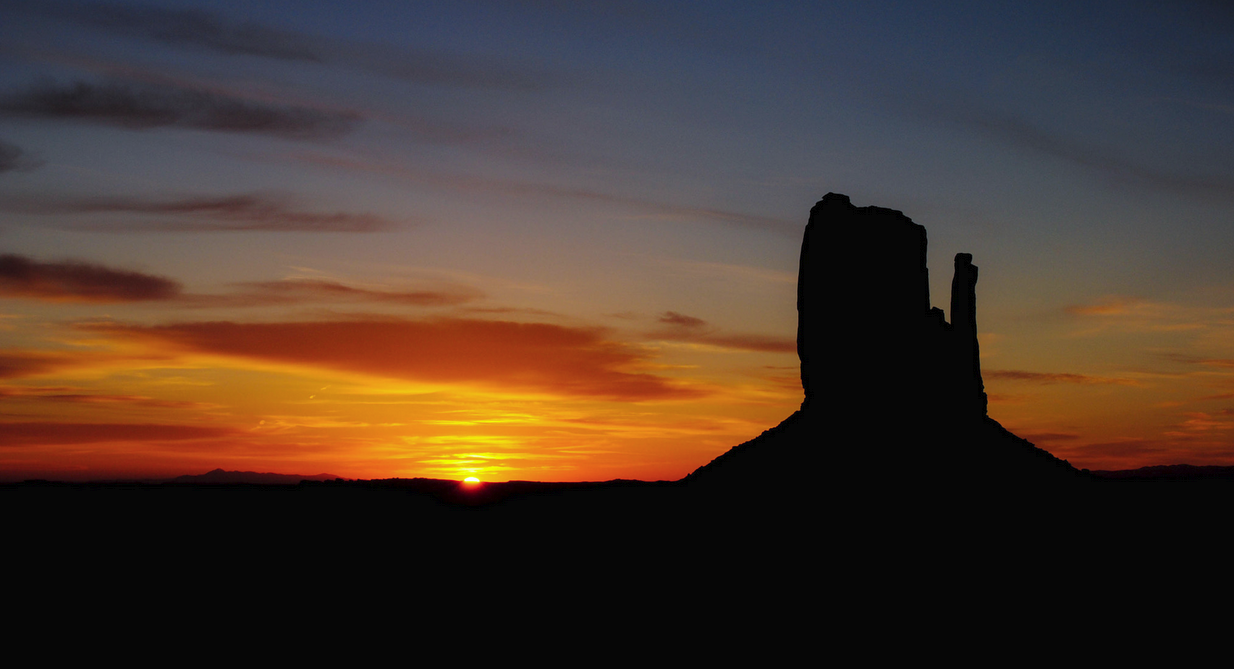
The essay speaks of “locomotive traveling”, and I am reminded of a tour I did 15 years ago through the American Southwest. I recall watching the sunrise in Monument Valley, yearning to lean into the connection between my body and the land, but being very much contained by the Navajo protocol. Keep to the road, tourist, then leave.
I complied. They knew what I did not yet understand: I came for an experience, they remain for the land.
It’s interesting to me to observe the correlation between imperialism and leisure travel. At least in Western history, we see the practice first arise in Roman times, only to fall during the Dark Ages, and resurface again in modern imperial Europe.[2] Due to the expense involved, leisure travel was restricted to nobility and royalty - only with the advent of modern transport infrastructure did such vacations become available to the masses.
Fast forward to today and it seems there is a distinction worth drawing - between travelling and the idea of travelling. Whether it’s a resort, a retreat, or some bespoke enlightened lodging situation - an experience is being created and sold in your mind as an idea of travelling. The empire of money and the colonization of the planet and its peoples facilitate this ideation. Capitalist salesmanship leans on storytelling to refine your idea into an experience. Time, artificially constrained by the social order, drives the efficient transfer of experience - and its price.
This pattern of conquer-then-consume doesn’t seem to me to be tied to Western imperialism, although that may be the flavor du jour. I can imagine any nobleman from any kingdom or empire performing similar acts of tourism - always removed, always at a distance. Even modern psychedelic tourism, born from the bowels of Burning Man, with all its promises of integrative and indigenous experiences, end up with strangers retreating in isolation, with ceremonies designed to meet their expectations.[3]
Even though on that old tour, I traveled to experience the beauty and strangeness of unfamiliar lands, this exactly was an act of doing. Like a Spaniard seeking gold, I had an story in my mind of what I wanted, and I went out and I found it.
It’s two months after my mother has passed when I encounter the grief.
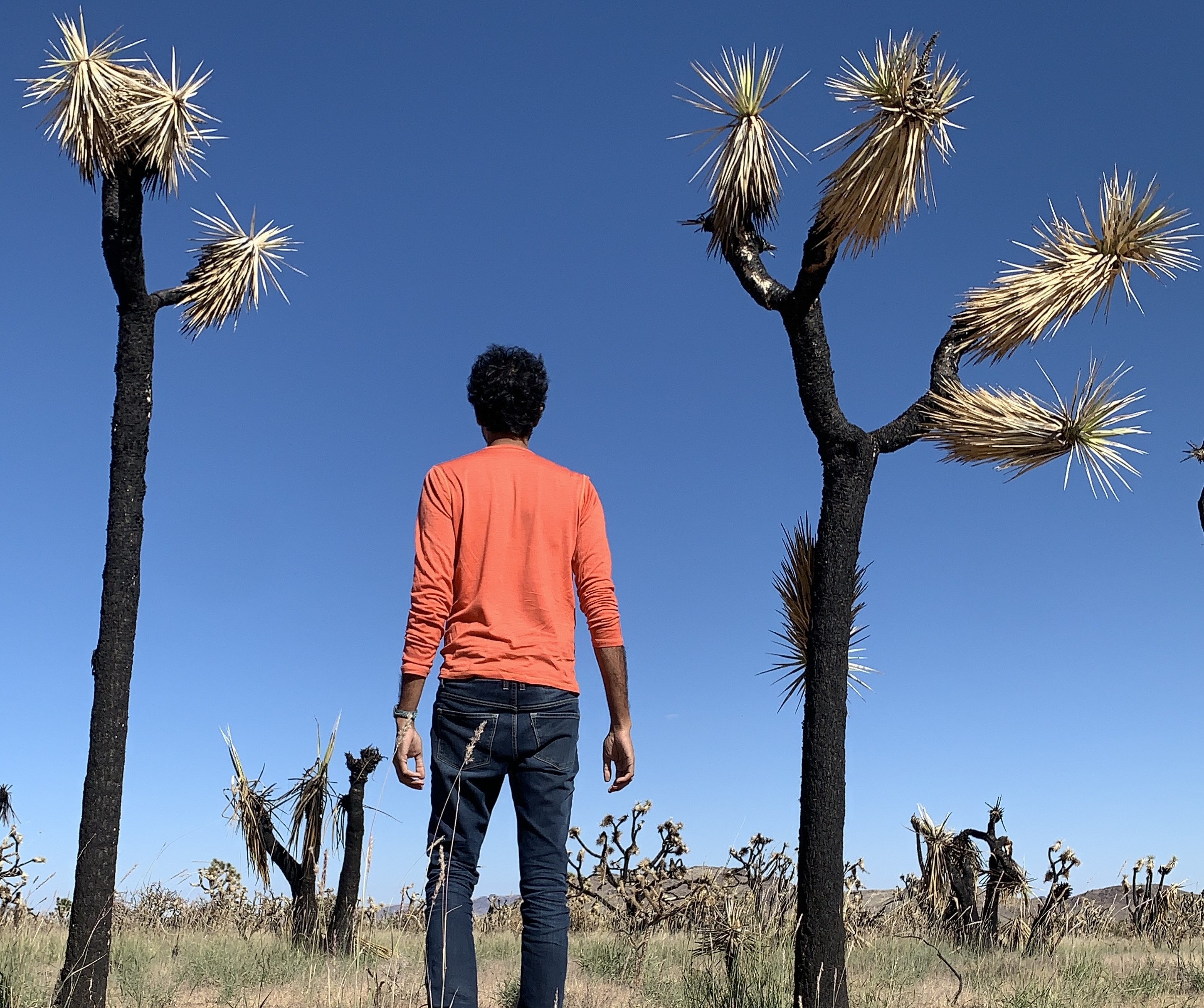
A wildfire has swept through the largest grove of Joshua trees out in the Mojave National Preserve. Wildfires, sparked by dry lightning, are not uncommon to the area. The vegetation is rather sparse and damage is typically localized. However in recent generations, invasive cheatgrass has taken root here and spread, brought over the years by travelers and their vehicles. Grass fires accelerate and intensify the flames, creating conditions the Joshua trees simply cannot survive.
I step out of my car, eyes red, feet bare. The ground aches for water. The sky begs for sound.
Here there is no postcard to experience, no view to behold, no story to consume. There are lava tubes somewhere, maybe, for those who feel the need to see it. Otherwise it is hundreds of miles of desolation, dotted with sage brush, yucca trees, flash flood gullies, and the occasional faded map bolted to a shaded wooden frame. I traveled here with little agenda other than to experience this devastation, but nothing could have prepared me for its scale.
The land shakes me with a torrential grief. It is reality - simple, pure, and unfiltered by human perception.
The grasses thrive. The trees wither. There is nothing to do but sit, and bear witness.
Travel is fun, and also a class-restricted privilege.[4] Philosophically I agree with the essayist that the benefits of travelling are overstated. I am also partial to the mind of G.K. Chesterton and I am tickled to find agreement with him here.
But I don’t think the average tourist is guilty of believing in their travels as some virtuous means towards self-fulfillment. It more just seems like they are choosing a slightly different way to pass the time until they die. If you have the privilege, why not exercise it?
I think some clarifying questions are helpful in assessing your relationship to travel:
- Are you traveling to escape your current life environment?
- Are you traveling to accumulate experiences and stories?
- Are you feeling called or summoned to a particular travel?
- What else would you do if you did not embark on this travel?
- Who else would you be if you never traveled again?
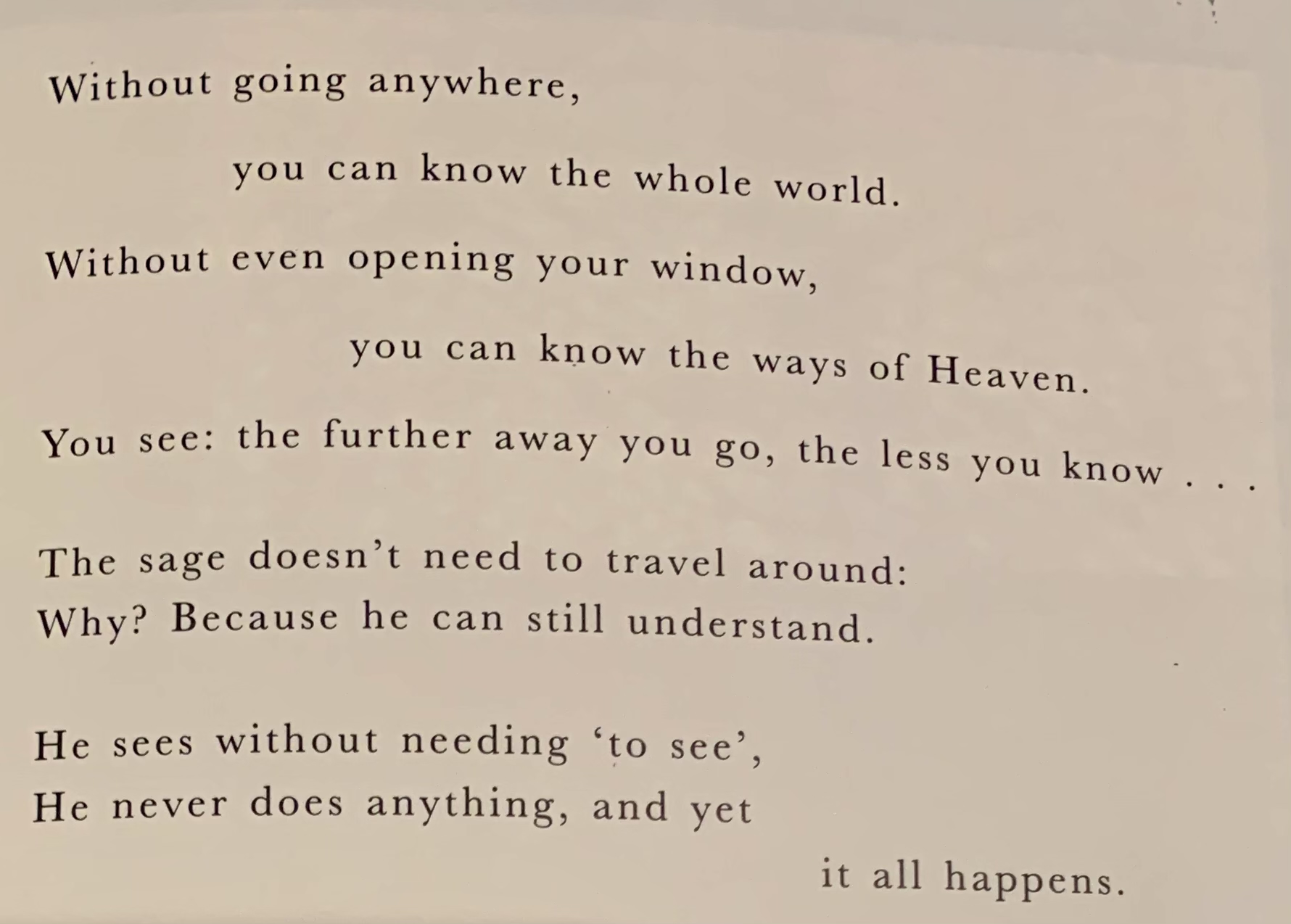
When answering these questions for myself I keep close verse 47 of the Tao Te Ching.[5] For myself I have found that unless my body feels summoned to a particular journey, the experience is likely to remain a shallow and ephemeral one. Knowing that awe can be experienced anytime, anywhere - why not here, now?